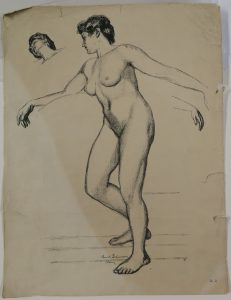
Ernst Liebermann (1869 – 1960)
Biography
The German painter, printmaker, and illustrator Ernst Liebermann was born in 1869 in Langemüss and passed away in 1960 in Beuerberg, Germany.
He studied under the guidance of Josef Scheurenberg at the Academy of Fine Arts in Berlin (1890–1893), winning the Academy’s gold medal in 1893. He undertook several study trips through Germany and Italy, alongside a longer stay in Paris. He worked primarily in Langemüss and, from 1897, in Munich, where he initially became a member of the Luitpoldgruppe art association. After 1907—the year he was awarded the title of professor—he joined the New Munich Artists’ Association (Neue Münchner Künstlergruppe), embarking on a highly active exhibition career. In Munich, he originally dedicated himself to the graphic arts (lithographs of landscapes and cities) and the illustration of books and magazines (e.g., Jugend)—notably producing highly acclaimed illustrations for the fairy tales of the Brothers Grimm—before turning to painting. Influenced by both Romanticism and Impressionism, he primarily painted portraits, female figures, nudes, genre scenes, landscapes, and interiors. He also executed the frescoes on the ceiling of St. Lawrence’s Church in Kirchheim.
As a member of the Association of German Artists (Deutscher Künstlerbund), he regularly exhibited at the Munich Glass Palace (Glaspalast), where he was awarded a gold medal in 1913. Following World War I, his artwork was embraced by the National Socialist conception of art to promote traditional family values, sports, and German military victories. As a result, he was repeatedly featured in the Great German Art Exhibitions held at the Haus der Kunst in Munich. In 1943, Liebermann’s studio in Munich was bombed, destroying numerous of his works. In 1944, Adolf Hitler and Joseph Goebbels included him in the Gottbegnadeten-Liste (God-gifted list), a compilation of 1,041 artists deemed indispensable to the culture of National Socialist Germany.
Today, his works can be found in collections and museums across Germany, including Berlin, Munich, Jena, Rosenheim, Erfurt, Nuremberg, Karlsruhe, and Weimar.
Other work from Ernst Liebermann (1869 – 1960)