Parthenis Konstantinos (1878 – 1967)
Biography
The painter Konstantinos Parthenis was born in Alexandria, Egypt, in 1878 or 1879 and passed away in Athens in 1967.
He began studying painting and music in Vienna at the age of just 16 (1895/96–1903). In 1903, he came to Athens. He traveled to various cities in Greece (Kavala, Constantinople, Poros, where he created the frescoes for the church of Agios Georgios, 1906–1907) and in 1907 to Egypt (from Alexandria to Luxor). In Cairo, he painted the iconography for the church of Agios Georgios. From 1909 to 1911, he lived in Paris, and from 1911 to 1917, in Corfu. He subsequently settled in Athens. In 1919, he painted icons for the church of Agios Alexandros in Palaio Faliro.
He was a founding member of the Techni (Art) group.
In 1929, he was appointed professor at the Athens School of Fine Arts, where he remained until 1947. In 1940, he was commissioned to decorate the southwestern hall on the first floor of the Athens City Hall. Although Parthenis executed the commission (1940–1942)—with works referring thematically to antiquity, Byzantium, and modern Hellenism—the pieces were ultimately never delivered due to financial disputes.
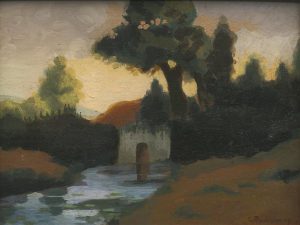
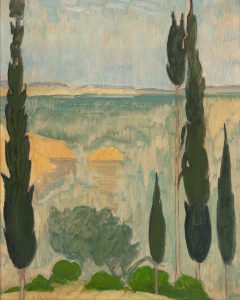
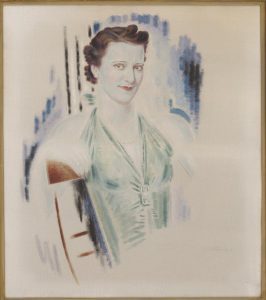
The goal of his painting was the promotion of a Helleno-centric ideology. Within this framework, he selectively assimilated principles primarily of Symbolism and Cubism, combining them with elements or themes from Greek tradition. His works, always contextualized within the spirit of Symbolism, are classified into three periods: a) the 1910s, with clear influences from the Vienna Secession, b) from 1917 until the end of the 1920s, during which influences from the work of Cézanne are discernible, and c) the 1930s onward, when he gradually reduced color and sharp outlines, resulting in paintings that look like abstract renderings of drawings on the raw texture of the canvas.
His first solo exhibition was organized in 1920 at the Zappeion. In 1938, he represented Greece with a solo exhibition at the Venice Biennale. He participated in numerous group exhibitions both in Greece and abroad.
Other work from Parthenis Konstantinos (1878 – 1967)