Kees van Dongen (1877 – 1968)
Biography
The painter Kees van Dongen was born in Delfshaven, near Rotterdam, in 1877 and passed away in Monte Carlo in 1968.
He studied at the Rotterdam Academy of Fine Arts and, from 1897 onwards, lived primarily in Paris.
He collaborated on the illustration of well-known magazines (L’Assiette au Beurre, Revue Blanche, Frou-Frou) in a style reminiscent of Toulouse-Lautrec.
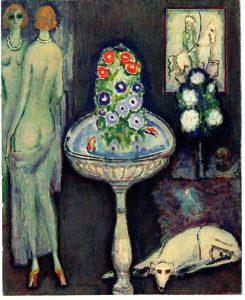
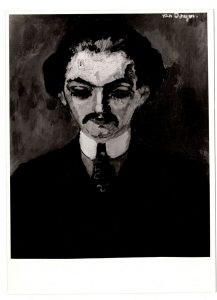
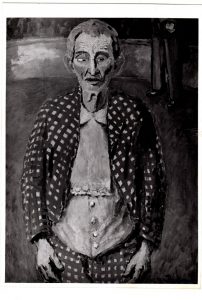
During the first phase of his painting, influenced by Rembrandt, his colors were dark; however, from the mid-90s, his palette gradually brightened and his brushwork became charged with energy. His Fauvist period (1905–1912) is considered his most significant. His favorite subject was women as figures of erotic desire, wherever he encountered them—from the street to the circus, the theater, and the music hall. After 1918, he focused particularly on female portraiture, establishing a specific type in which the face, with its large eyes, and the hands are rendered in detail, in contrast to the background which remains almost neutral with only a few strokes of vivid color. He also painted flowers that moved away from the conventional still life. Finally, in lithography, he found the medium that best responded to the character of his line.
Other work from Kees van Dongen (1877 – 1968)