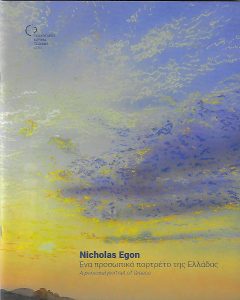
Nicholas Egon (1921 – 2017)
Biography
Born in Brno, Czechoslovakia in 1921, of aristocratic descent, he made the decision at the age of 16 to leave his paternal home and pursue his own dreams. After a stay in Cannes, he arrived in London, where he engaged in creating cinema posters. Concurrently, he attended classes at Birkbeck College at the University of London.
In 1940, he served in the Czech Army as a war designer, and after the war, he worked at the Royal Air Force College of Fine Arts in Cairo. Later, he worked at the architectural office of Ernö Goldfinger while teaching at Sir John Cass College (1946-1950) and delivering lectures at the National Gallery. During that period, he participated in group exhibitions alongside significant artists such as Roberto Matta and Henry Moore. He also came into contact with surrealism artists like Roland Penrose, Jack Brunius, and E.L.T. Mesens.
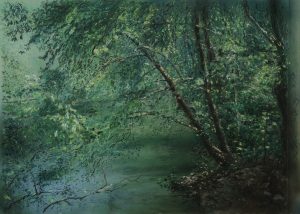
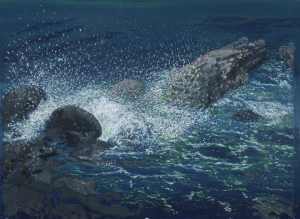
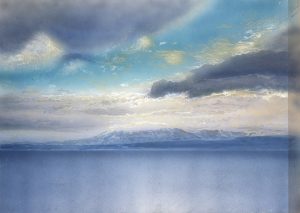
In 1949, Egon traveled to Greece, where he created portraits of King Paul I and Queen Frederica, as well as other members of the royal family. In Greece, Egon came into contact with the recent events of the Occupation and the Civil War (he observed the battles in Vitsi and Grammo) and undertook the creation of a triptych commissioned by King Paul. During his stay in the country, Egon depicted women, refugees, rebels, and orphaned children. Simultaneously, he continued his successful career as a portraitist of high European society. Notably, in the 1980s, he created royal portraits of King Hussein and Queen Noor of Jordan, along with other members of the royal family. Another significant aspect of Egon’s art is his landscape painting.
From 1989, he was elected Chairman of Patrons of the Centre for Hellenic Studies at King’s College, London, and in 1990, he played a crucial role in establishing the annual Runciman Lecture.