Semertzidis Valias (1911 – 1983)
Biography
The painter and printmaker Valias Semertzidis, son of a Greek father and a Russian mother, was born in Ekaterinodar (later Krasnodar) in the Caucasus region of Southern Russia in 1911 and passed away in Athens in 1983, where his family had settled in 1922.
He learned painting under N. Petridis. Upon completing the preparatory department of the Athens School of Fine Arts (1928–1932), he chose the studio of Konstantinos Parthenis (1932–1936), whose influence is prominent in his early works, particularly his landscapes. In 1936, he joined the “Free Artists” Association (1935–1940), a collective composed predominantly of left-wing creators who stylistically promoted realist trends. He participated in the National Resistance within the ranks of EAM, an experience that was profoundly captured in his art through portraits and multi-figure compositions executed in a bold, rugged realist manner on wide surfaces with stark color contrasts. His subsequent works include landscapes and scenes depicting the daily life and toil of ordinary people. Although self-taught, he engaged with printmaking from the late 1940s onward; drawing inspiration from the same thematic repertoire, he invented his own distinct technique, execution etchings featuring white contours against a primarily black subject matter. He lived for long periods in Rhodes (1965–1983), where he painted large public murals for hotels, taverns, and the Chamber of Commerce. Concurrently, he illustrated magazines, designed cinema posters, and taught dance classes at his father’s dance school.
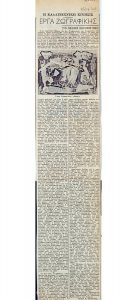
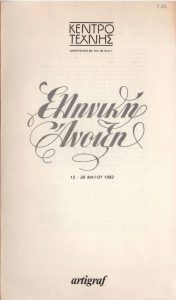
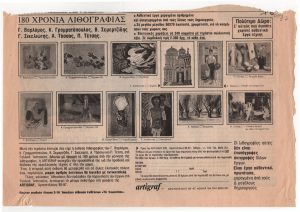
He presented his artwork in solo exhibitions (including in Athens, Eleusis, Thessaloniki, Rhodes, and Lamia, a touring exhibition across 25 cities in the USSR from 1967 to 1970, as well as in Birmingham, Ferrara, and Livorno). He also participated in group exhibitions in Greece (e.g., the Panhellenic Art Exhibitions of 1939, 1940, 1957, 1963, 1965, and 1967) and abroad (e.g., Cairo International Exhibition 1946, 6 Contemporary Greek Painters in London 1946, Grekisk Konst in Stockholm 1947, Contemporary Art in Greece in Moscow 1963, the Alexandria Biennale in 1959 and 1963, the International Printmaking Exhibition in Leipzig 1965, and the Salon des Comparaisons in Paris 1982).
His works are preserved in the Museum of Modern Greek Art of Rhodes, the National Gallery of Greece, the Manos & Anastasia Faltaits Folk and Ethnographic Museum, and the Municipal Art Galleries of Larissa and Nikaia, among others
Other work from Semertzidis Valias (1911 – 1983)