Pavlos (Dionyssopoulos) (1930 – 2019)
Biography
The visual artist Pavlos (Dionyssopoulos) was born in Filiatra, Messenia, in 1930 and passed away in Athens in 2019. He was married to the painter Ioanna Asmani.
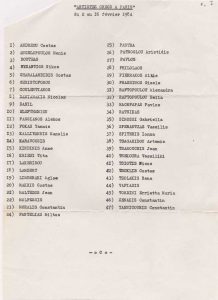
As a child, he began sketching his surroundings and the people living in them. He studied at the Athens Supreme School of Fine Arts in the studio of G. Moralis (1949–1953). In 1954, with a scholarship from the State Scholarships Foundation (IKY), he continued his studies in Paris at the Académie de la Grande Chaumière. During the same period, he traveled to Spain, the Netherlands, and Germany. Immediately after, he worked in Athens in the fields of advertising and theatre, creating numerous stage sets (1955–1958). In 1958, receiving a three-year scholarship from IKY, he settled permanently in Paris and established his workshop. There, he came into contact with many prominent artists, such as Raymond Hains—founder of the “New Realists” (Nouveaux Réalistes) movement—sculptors César, Alberto Giacometti, Alexander Calder, and Jean Dubuffet, as well as the critic and philosopher Pierre Restany, who exerted significant influence on contemporary art.
He developed an original technique using printed paper from magazines and posters as raw material, with which he constructed three-dimensional objects and environments. In the late 1970s, he abandoned the representational style of his previous work to create abstract compositions using laminated ribbons. From the 1980s onward, he returned to representing the natural environment while beginning to explore new methods of processing paper.
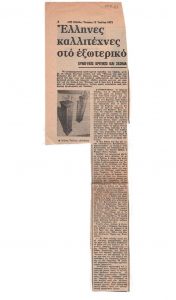
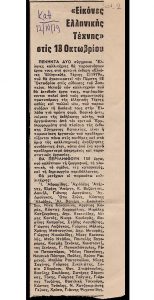
His works were presented in solo exhibitions (e.g., in Paris, New York, Hanover, Athens, and Thessaloniki) as well as in group and international exhibitions (e.g., the Alexandria Biennale 1958; Paris Biennales 1965 and 1978; Venice Biennale 1980, where he represented Greece; and Europalia 1982).
His works are held in the National Gallery–Alexandros Soutzos Museum, the Basil & Elise Goulandris Foundation, the National Museum of Contemporary Art, the European Parliament, the Centre Pompidou in Paris, the Hamburger Kunsthalle in Hamburg, MoMA in New York, and the Mumok in Vienna.
Other work from Pavlos (Dionyssopoulos) (1930 – 2019)