Savvidis Symeon (1859 – 1927)
Biography
The painter Symeon Savvidis was born in Tokat, Asia Minor, in 1859 and passed away in Athens in 1927.
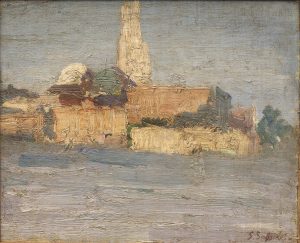
He initially studied at the Commercial School of Halki and then studied architecture at the School of Arts in Athens (1878–1880). With the financial support of S. Zafeiropoulos, a member of the Greek diaspora in Marseille, he went to Munich to continue his studies in painting. At the Academy, his teachers included L. von Löfftz, J. von Benczur, W. von Diez, and Nikolaos Gyzis. He visited Constantinople (1890) and subsequently remained in the Pontus region until 1905. His works from the 1895–1900 period belong to the context of Orientalism and are characterized by a plein-air approach. In 1925, he settled permanently in Athens.
While in Tokat, Pontus (1905), he began writing a study titled ‘Erga kai Parerga’ (Works and By-products), which he completed in Munich (1922). Written in German, this manuscript constitutes the most important source of information regarding his life and work, and it is kept at the National Gallery.
He developed a rich artistic activity, participating in solo and group exhibitions, such as the International Exhibitions in Munich (1901), Berlin, Leipzig, Hamburg, Vienna, Paris (1900), and London (1895), where he was awarded a silver medal. In 1931, the Lyceum Club of Greek Women organized a major retrospective exhibition of his work.
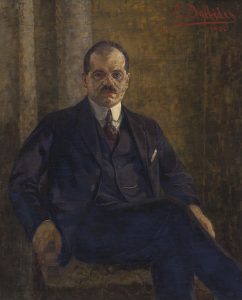
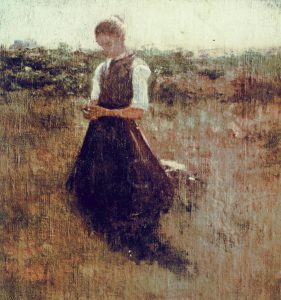
He engaged with almost all genres of painting, avoiding allegorical and historical scenes. Around 1893, he abandoned the strict composition and realistic representation of nature that he had initially pursued (1880–1893) in accordance with the academic standards of the Munich School, and developed his own personal style, implementing his own theories regarding color and light.
Other work from Savvidis Symeon (1859 – 1927)