Pantazis Periklis (1849 – 1884)
Biography
The painter Periklis Pantazis was born in Athens in 1849 and passed away in Brussels in 1884.
With the encouragement of his family, he studied at the School of Arts under Nikiforos Lytras (1866–1871), where he won awards and scholarships for several consecutive years. While still a student, he participated in the 1870 Olympia Exhibition, where he distinguished himself. The following year, he graduated and enrolled at the Munich Academy of Fine Arts (1871); however, he left after one year—likely unable to comply with its strict rules—to move to Paris. There, he came into contact with the painting of Courbet and other pioneers of the era, such as Boudin, Manet, and the impressionists Monet and Degas.
In 1872, he settled in Brussels, where he remained until his death. He was immediately accepted by his fellow artists there, joining groups such as the Artistic and Literary Circle (Cercle Artistique et Littéraire) and the Chrysalis Circle (Cercle de la Chrysalide), and built social ties with art-loving bourgeois families of Brussels who purchased his works. In 1878, he represented Greece at the Salon and the Exposition Internationale Universelle in Paris, and in 1880, he visited Athens, where he stayed for a year. Upon his return to Brussels in early 1881, he showed his first symptoms of tuberculosis. Despite his illness, in 1883 he participated in the founding of the Circle of the Twenty (Les XX), an avant-garde group that helped link his painting to European modernism. His already strained health deteriorated due to tuberculosis, from which he passed away in 1884.
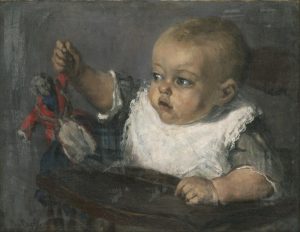
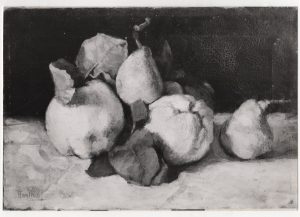
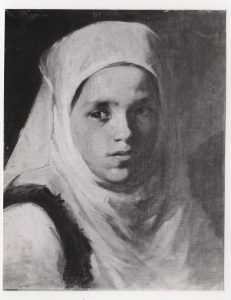
Pantazis presents a particularly rich variety of subject matter and continuous experimentation with various techniques. Portraits constitute a significant part of his artistic creation and are characterized by an effort to render the personality traits and inner psyche of the sitter. Generally, his works (portraits, genre scenes, landscapes, still lifes) are dominated by either subtle and rapid brushstrokes or broad and impasto applications. The influence of Courbet, along with that of Belgian realist painters, is discernible in both his thematic choices and stylistic execution.
In 1996, a retrospective exhibition of his work was organized by the E. Averoff Gallery in Metsovo and the National Gallery in Athens.
Other work from Pantazis Periklis (1849 – 1884)