Gaitis Yannis (1923 – 1984)
Biography
The painter, engraver and sculptor Yannis Gaitis was born in Athens in 1923, where he also passed away in 1984.
He graduated from the Athens School of Fine Arts in 1951 and, three years later, left for Paris, where he continued his studies at the École des Beaux-Arts and the Académie Grande Chaumière.
In 1949, he participated in the founding of the ‘Akraioi’ (Extremists) art group, composed of artists exploring various aspects of abstract art.
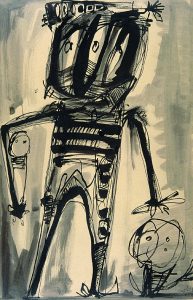
He was initially influenced by the Cubism of Picasso and Braque, as well as geometric abstraction in portraits and island landscapes, particularly of Hydra and Santorini. From 1957–1958, he turned toward Abstract Expressionism and biomorphic Surrealism, depicting zoomorphic mythical entities and humanoids on two-dimensional surfaces, before moving shortly after toward a highly gestural abstraction. In 1967, he introduced his signature ‘Little Men’ (anthroparia)—standardized male figures in striped suits and hats. These significant, ironic figures served as symbols of massification and, from 1974 onwards, were unified and integrated into space as constructions, stage sets, or functional objects.
He maintained significant exhibition activity, presenting his work simultaneously in Athens and Paris, where he lived with his wife, the sculptor Gabriella Simosi.
He also engaged in social and theatrical happenings, book illustrations, set and costume design, textile patterns, and more.He presented his work in solo and group exhibitions across Greece, Europe, and the Americas. He participated in numerous international exhibitions, including the São Paulo Biennales of 1952 and 1967, and Europalia 1982 in Brussels. Retrospectives were organized at ‘Trito Mati’ (1977), the National Gallery of Greece (1984), and the Vafopoulio Cultural Center (1994).
On September 14, 2024, the Gaitis–Simosi Museum was officially inaugurated on the island of Ios.