Ventouras Nikolaos (1899 – 1990)
Biography
The painter and printmaker Nikolaos Ventouras, a scion of an aristocratic family of Venetian origin, was born in 1899 in Corfu, where he also passed away in 1990.
He studied Industrial Chemistry in Athens in 1916 at the private Industrial and Commercial Academy. From 1931 to 1937, he received watercolor lessons from the prominent Corfiot painter Angelos Giallinas. Beginning in 1932, he engaged with all forms of printmaking; he was a self-taught printmaker, with the sole exception of lithography, in which he received formal instruction. Utilizing his background in chemistry, he experimented extensively with materials and acid-biting times, managing to capture his envisioned images with absolute precision. Through his persistence, he contributed significantly to the evolution of printmaking, establishing himself as one of its true pioneers.
Starting from a foundation of realism, Ventouras forged an abstract, expressionistic visual language interweaved with Cubist and Surrealist elements, becoming one of the very first artists in Greece to produce color copper plate etchings.
He also engaged with photography and book illustration, famously illustrating Konstantinos Theotokis’s social novel The Life and Death of Karavelas in 1928.
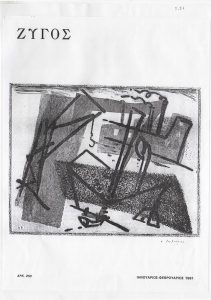
He held very few solo exhibitions in Athens (e.g., at the Athens Technological Institute in 1963 and the “Zygos” Gallery in 1981). However, he participated in numerous group exhibitions in Greece and internationally, including the Panhellenic Art Exhibitions from 1947 to 1987, the São Paulo Biennials (1955, 1957), the Alexandria Biennale (1957), the Tokyo Print Biennale (1957), the Venice Biennale (1964), and the Ljubljana International Graphic Arts Exhibition (1961).
His works are preserved in the National Gallery of Greece, the AGET Heracles Collection, the Alpha Bank Art Collection, the Benaki Museum (Gika Gallery), the Municipal Art Galleries of Corfu and Rhodes, and the University of Oregon among others.
Other work from Ventouras Nikolaos (1899 – 1990)