Makri Zizi (1924 – 2014)
Biography
The engraver and mosaic artist Zizi Makris was born as Luise Srnić in Belgrade in 1924, and passed away in Athens in 2014.
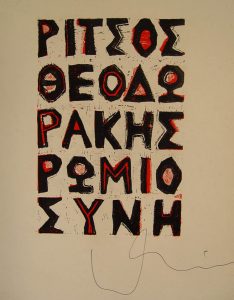
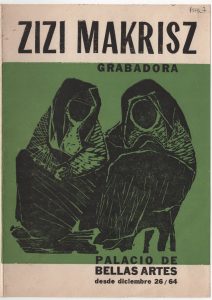
She was the wife of the sculptor Memos Makris. She studied at the Belgrade School of Fine Arts, and in 1946, thanks to a scholarship from the French government, she continued her studies at the École des Beaux-Arts in Paris, training in the printmaking workshop of Dimitris Galanis (1946–1950). She met Memos Makris in 1948, and they were married in 1950. In 1951, the French government deported them due to Makris’s leftist political beliefs and activism. They settled in Budapest, actively participating in its artistic life until their repatriation to Greece in 1978. In 1960, Zizi entered Greece clandestinely on a communist party assignment to help a high-ranking member of the KKE (Communist Party of Greece) escape abroad. She was immediately arrested and jailed as a political prisoner at the Averof Women’s Prison (1960–1961), where she sketched her fellow female inmates and the palm tree in the prison courtyard. These drawings were later turned into prints and exhibited in Budapest (1962) and at the “Zygos” Gallery in Athens (1963). In 1962, they also illustrated the publication of Yiannis Ritsos’s poetry collection, The Prison Tree and the Women.
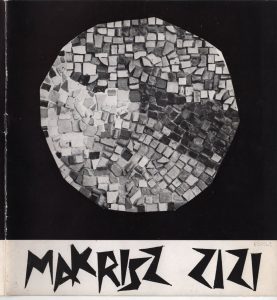
She engaged in mosaic art, tapestry, printmaking, and the illustration of poems by Yiannis Ritsos, Bertolt Brecht, and Paul Éluard, as well as publications for Hungarian, French, and Greek publishing houses. Her work primarily focuses on the labor and struggles of working-class people, as well as her travel experiences across Greece and the Eastern Bloc (such as China in 1956, Russia in 1962, Cuba in 1963, and Uzbekistan, Armenia, and Siberia between 1964 and 1966).
She showcased her work in solo exhibitions (in Paris, Budapest, Athens, Piraeus, Heraklion, Corinth, Nicosia, China, Cuba, and Mexico) and in group and international printmaking and woodcutting exhibitions in Greece, Cyprus, Spain, Germany, Austria, Switzerland, Hungary, and Japan. For her work, she won prizes at the 1st, 2nd, and 3rd International Printmaking Competitions of the World Federation of Democratic Youth in Berlin (1953), Warsaw (1955), and Moscow (1957). She was also twice awarded the prestigious Munkácsy Prize (1959, 1963) and received the Meritorious Artist of Hungary award in 1984, the highest honor for visual arts in the country. Her works adorn public and private spaces in Hungary (e.g., the Budapest City Hall) and Greece (e.g., the atrium of the Museum of Cycladic Art in Athens).
Other work from Makri Zizi (1924 – 2014)