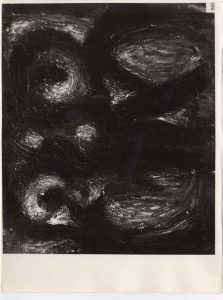
Sarafianos Panos (1919 – 1968)
Biography
The painter Panos Sarafianos was born in 1919 in Lamia and passed away in Athens in 1968.
He lived in Lamia until 1928, where he took his first painting lessons at the studio of his father, the painter Georgios Sarafianos. In 1928, he settled with his large family in Athens, where from the age of thirteen he worked in various commercial jobs while simultaneously attending night school. Together with his father and his brother, Nikos, they collaborated on painting the hagiography of Holy Churches in Spata and Karpenisi (1937–1940).
He studied under Dimitris Biskinis and Umbertos Argyros at the Athens School of Fine Arts (1939–1945), where he won praises and awards. During his studies, he was conscripted into the war of 1940 and later joined the National Resistance.
In 1947, he opened his homonymous painting workshop-preparatory school, which he maintained until his death, collaborating with Vrasidas Vlachopoulos and, shortly before his passing in 1968, his wife, the painter and ceramicist Mary Chatzinikoli-Sarafianou. Many later well-known painters graduated from this workshop, which taught not only art but also the philosophy surrounding it.
During his four-year stay in Rome (1956–1959) due to his wife’s studies, he studied the entirety of past Italian—and global—art alongside contemporary international movements, while also studying fresco painting and ceramics at the Istituto d’Arte. He painted the hagiography of the outdoor Holy Church of Agios Georgios at the Corinth military barracks and, in 1959, the Platytera of the Holy Church of Saint Andrew in Rome. In 1963, he was appointed as a museum artist at the National Archaeological Museum.
He held solo exhibitions in Athens (“Adel” 1954, “Neες Morfes” 1961, Athens College for Girls 1961) and participated in group exhibitions (e.g., Panhellenic Exhibitions 1952, 1960, 1963, La Spezia in Italy 1957, Paris Salon d’Art 1960, São Paulo Biennale 1961, Tel Aviv, Jerusalem, Brussels, Volos, Hydra, and Heraklion).
Other work from Sarafianos Panos (1919 – 1968)