Steris Yerassimos (1898 – 1987)
Biography
The painter Gerasimos Steris (Gerasimos Stamatelatos, Georges de Steris, Guelfo Ammon d’ Este) was born in Digaleto, Kefalonia, in 1898 and passed away in New York in 1987.
He graduated from the Franco-Hellenic Lyceum of Alexandria, where his family had immigrated. He attended the Athens School of Fine Arts under D. Geraniotis, Sp. Vikatos, and G. Iakovidis, where he distinguished himself by winning three major awards (1915-1917).
In 1917, he interrupted his studies to serve in the military. Through the mediation of Notis Botsaris, he served in the Mapping Service of Athens until 1919.
Subsequently, he toured Europe (Italy, Munich, Amsterdam). A major turning point in his life was meeting De Chirico in Rome. He stayed in Paris (1927-1931), where he attended classes at the Académie Julian, studied philosophy and psychology at the Sorbonne, and fresco painting and interior architecture at the École des Beaux-Arts; at the same time, he came into contact with artists such as P. Picasso, A. Derain, and G. Braque. In Paris, he met the art dealer M. Segredakis, who remained his loyal supporter until his death (1948).
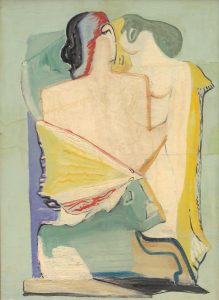
With an already developed Cézannesque-Cubist idiom and Helleno-centric themes, he returned to Greece in early 1931. The avant-garde character of his work divided opinions, resulting in negative reviews from the then Director of the National Gallery, Zacharias Papantoniou. Prominent intellectuals, including F. Politis, S. Melas, and D. Pikionis, defended him with a manifesto.
Until late 1936, when he left for the U.S.A., he worked as a set designer for theatrical productions with D. Pikionis (1932) and on the restorations of Mystras with F. Kontoglou (1935).
During his stay in the U.S.A., he gave painting lessons, worked for 20th Century Fox, undertook the decoration of the Greek Pavilion at the New York World’s Fair (1938), and curated the hagiography of churches in New York and Lowell, Massachusetts. In 1949, he changed his name to Guelfo Ammon d’Este.
In 1980, he lived for a period of time in Nice, France.
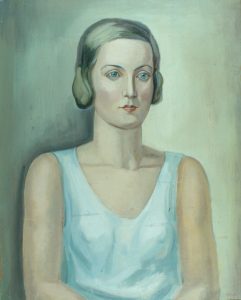
He is considered a pioneer of Greek Modernism, introducing a visual vocabulary with symbolic undertones and references to metaphysical art. From the abstract form of his early creations, he was led to a more realistic style with a decorative disposition in the works he produced in America.
Other work from Steris Yerassimos (1898 – 1987)